Home Blog Page 12

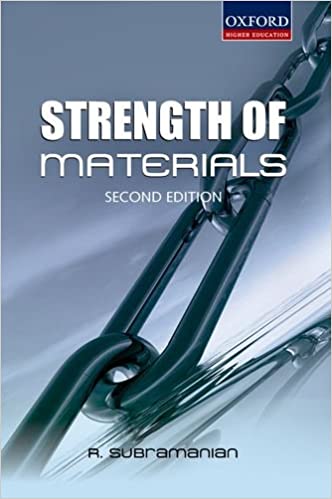
[PDF] Strength of Materials By R. Subramanian

Strength of Materials Book Pdf Free Download

Strength of Materials By R. Subramanian

Strength of Materials is book for mechanical engineering students by R. Subramanian, published in 2010.

Beginning with an introduction to the basic concepts of stresses in simple and composite elements, strains, and deformation of solids, the book moves through discussions on loads and stresses on the beam, which is a common structural element, torsion, and beam deflection. It then discusses columns and analysis of stresses in two dimensions. the boko also deals with strain energy concepts and their applications.

The book provides an exhaustive coverage of important topics such as temperature stresses. elastic constants, bending moments, shear forces, theory of simple bending, analysis and design of shafts, stepped, indeterminate and compound shafts, close- and open-coiled helical springs, Euler equations and Rankine formula for columns, and Mohr’s circle.

TO reinforce the theoretical concepts, the text is supplemented by a large number of worked-out examples with step-by-step solution procedures as well as a large number of review questions and exercise problems. The text is also well supported by a large number of detailed illustrations.

Table of contents :

Content: Review of basic concepts —
Properties of sections —
Simple stresses and strains —
Bending moments and shear forces —
Stresses in beams —
Combined direct and bending stresses —
Deformations in beams —
Torsion —
Analysis of principal planes, stresses, and strains —
Strain energy —
Columns —
Special topics —
Pin-jointed plane frames —
Introduction to indeterminate structural analysis —
Fixed and continuous beams.

Strength of materials PDF

Author(s): Subramanian, R

Series: Oxford higher education

Publisher: Oxford University Press, Year: 2010

ISBN: 0198061102

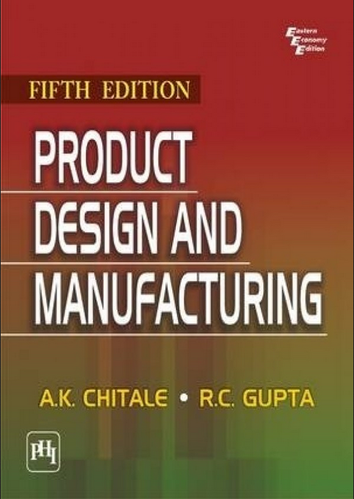
[PDF] Product Design and Manufacturing

Product Design and Manufacturing Book Pdf Free Download

Product Design and Manufacturing By A. K. Chitale and R. C. Gupta

Product Design and Manufacturing is Gtu Reference book for B.tech  Mechanical Engineering Branch Students in Engineering Fourth Year by A. K. Chitale and R. C. Gupta.

This well-established and widely adopted text, now in its Fifth Edition, continues to provide a comprehensive coverage of the morphology of the design process. It gives a holistic view of product design, which has inputs from diverse fields such as aesthetics, strength analysis, production design, ergonomics, reliability and quality, Taguchi methods and quality with six sigma, and computer applications. The text discusses the importance and objectives of design for environment, and describes the various approaches by which a modern, environment-conscious designer goes about the task of design for environment. Many examples have been provided to illustrate the concepts discussed. NEW TO THIS EDITION: Includes sections on welding processes, metal cutting theory, microfinishing operations, workplace layout from ergonomics considerations, noise, heating and ventilating and lighting. Gives Review Questions at the end of each chapter, with hints and solutions to some questions. Discusses various types of models used by designers. Designed primarily as a text for courses in mechanical engineering, production engineering, and industrial design and management, the book should also prove very handy for practising engineers. KEY FEATURES: Provides concepts from material science, which include inputs on ceramics, rubber, polymers and other materials to make the design idea physically realizable. Uses the modern Concurrent Design concept to satisfy diverse groups/areas such as marketing, vendors, production, and quality assurance. Considers the use of computers while analyzing modern techniques of prototyping, simulation of product and its use. Introduces AI, robots, AGV, PLC and AS/RS in manufacturing automation.

PRODUCT DESIGN AND MANUFACTURING PDF

Author(s): A. K. CHITALE, R. C. GUPTA

Publisher: PHI Learning Private Limited, Year: 2013

ISBN: ,

(7.3 MB)

Download

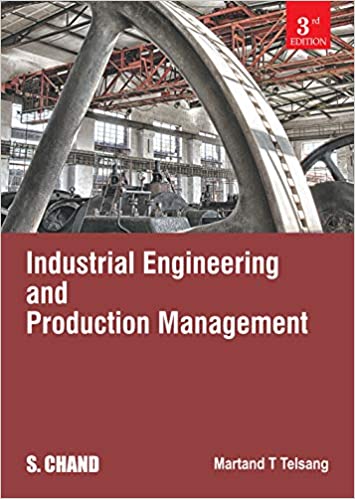
[PDF] Industrial Engineering and Production Management

Industrial Engineering and Production Management Book Pdf Free Download

Industrial Engineering and Production Management By Martand T Telsang

Industrial Engineering and Production Management is book for mechanical engineering students by Martand T Telsang, published in 2018.

For close to 20 years, “Industrial Engineering and Production Management” has been a successful text for students of Mechanical, Production and Industrial Engineering while also being equally helpful for students of other courses including Management.,
Divided in 3 parts and 38 chapters, the text combines theory with examples to provide in-depth coverage of the subject.

Key Features:
  • The text carries 12 supplementary write-ups (incl. QFD, DFMA, SLP and SHA), additional solved problems and 5 appendices.
  • More than 300 problems (with solutions), figures and tables aid to the concepts explained.
  • Close to 500 chapter-end questions reinforce the concepts by providing adequate practice.
Table of Content :
  • Introduction to Industrial Engineering
  • Productivity
  • Work-Study
  • Method Study
  • Work Measurement
  • Value Engineering
  • Plant Location
  • Plant Layout
  • Material Handing
  • Job Evaluation and Merit Rating
  • Wages and Incentives
  • Ergonomics
  • Part II: Production Management
    • Introduction to Production/ Operations Management
    • New Product Design
    • Demand Forecasting
    • Production Planning and Control
    • Capacity Planning
    • Material Requirement Planning (MRP)
    • Process Planning
    • Project Scheduling with CPM and PERT
    • Production Control
    • Inventory Control
    • Production Cost Concepts and Break-Even Analysis
    • Maintenance Management
    • Make or Buy Decisions
    • Planning and Control of Batch Production
  • Part III: Advanced Topics in Production Management
    • Application of Linear Programming Technique in Production Management
    • TQM – Concept and Philosophy
    • Business Process Reengineering
    • Group Technology
    • Just In Time (JIT) Manufacturing
    • Operations Strategy
    • Materials Management
    • Project Management
    • Service Management
    • Product and Service Reliability
    • Theory of Constraints (TOC)
    • Advanced Manufacturing Technologies and Systems
    • Supplements – 12
    • Additional Solved Problems on 11 topics
    • Appendices – 5

Industrial Engineering and Production Management PDF

Author(s): Martand T. Telsang

Publisher: S. Chand Publishing, Year: 2018

ISBN: 9789352533794


Download

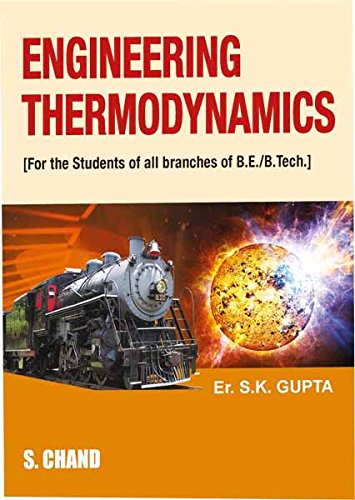
[PDF] Engineering Thermodynamics (S. Chand) by S K Gupta

Engineering Thermodynamics (S. Chand) Book Pdf Free Download

Engineering Thermodynamics SK Gupta PDF Free Download Link is available at the End of Article.

Engineering Thermodynamics (S. Chand) By S K Gupta

Engineering Thermodynamics (S. Chand) is book for mechanical engineering students by S K Gupta, published in 2013.

Continuing the tradition of the best selling textbooks, this first edition “Engineering Thermodynamics” is a comprehensive reference to the broad spectrum of thermodynamics, encapsulating the theoretical and practical aspects of the field. The author addresses a myriad of topics, covering both traditional and innovative approaches. Additionally, the book includes numerous tables.


Currently third party Downloading link (not uploaded by freepdfbook.com) removed due to copyright infringement material, Our site does not support to share this of material.

Support to Author by Buying Paperbook from link given below…

Original Link of Material :

https://www.schandpublishing.com/books/tech-professional/mechanical-engineering/engineering-thermodynamics-2e/9789352834051/


Engineering Thermodynamics PDF

Author(s): S.K. Gupta

Publisher: S. Chand Publishing

Year: 2013

ISBN: 8121942705

[PDF] Machinery’s Handbook

Machinery’s Handbook Book Pdf Free Download

Machinery’s Handbook By Erik Oberg, Franklin Jones, Holbrook Horton, Henry Ryffel

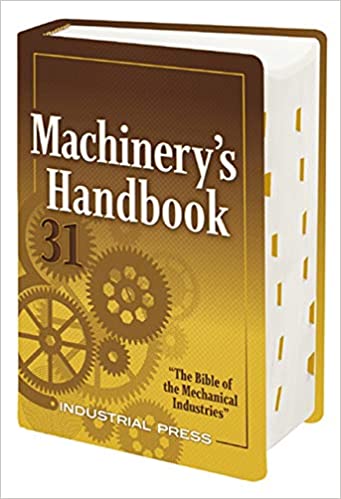
Machinery’s Handbook (Toolbox Edition) is best book in mechanical engineering by Erik Oberg, Franklin Jones, Holbrook Horton, Henry Ryffel.

Since the first edition published more than 100 years ago, Machinery’s Handbook has been the most popular engineering resource of all time. Universally considered the principal reference in the manufacturing and mechanical industries, the Handbook is the ultimate collection of essential information needed by engineers, designers, drafters, metalworkers, toolmakers, machinists, educators, students, and serious home hobbyists. From engineering and design departments, machine and metalworking shops, and a wide range of manufacturing and industrial facilities, to countless classrooms and workshops worldwide, this is the must-have technical reference.

Machinery’s Handbook is acknowledged as an exceptionally authoritative and comprehensive, yet highly practical, and easy-to-use tool. The 31st edition of the “Bible of the Mechanical Industries” continues in this tradition, providing users with fundamental and essential aspects of manufacturing practices, including hundreds of ASME and ANSI standards updates and thousands of revisions to text, tables, equations, and figures.

New to the 31st Edition

  • Additive Manufacturing: Expert discussions, exploring 3D printing materials, techniques, and workflow, compare traditional machining to today’s additive manufacturing processes.
  • Machine Elements and Operations: Updated and expanded coverage of CAD/CAM operations, boring, nontraditional cutting methods, o-rings and glands, and transmission chains.
  • Manufacturing and Materials: Additional information on utilizing today’s plastics, powder metallurgy standard and tool steels, manufacturing stresses, and preventing corrosion.
  • Metal Casting and Molding: New information for working with iron, steel, nonferrous metals, and alloys, metal casting and molding processes, and modeling and design considerations.
  • Math, Measurement, and Dimensioning: Reorganized, revised, and expanded sections provide ready access to clear information, essential formulas, and everyday calculations and conversions.
  • Metalworking Processes: More on brazing, soldering, welding, nondestructive testing, forming sheet metal, mill finishes, passivation, electropolishing, and plating.
  • Threads and Threading: The latest series and selected combinations for Unified Screw Threads.

Machinery’s Handbook PDF

Author(s): Erik Oberg, Franklin Jones, Henry Ryffel, Holbrook Horton

Publisher: Industrial Press, Year: 2020

ISBN: 083114131X,9780831141318

Materials for High-Temperature Power Generation and Process Plant Applications

Materials for High-Temperature Power Generation and Process Plant Applications


Book Details :
Language English
Pages 361
Format PDF
Size 8.59 MB

Materials for High-Temperature Power Generation and Process Plant Applications


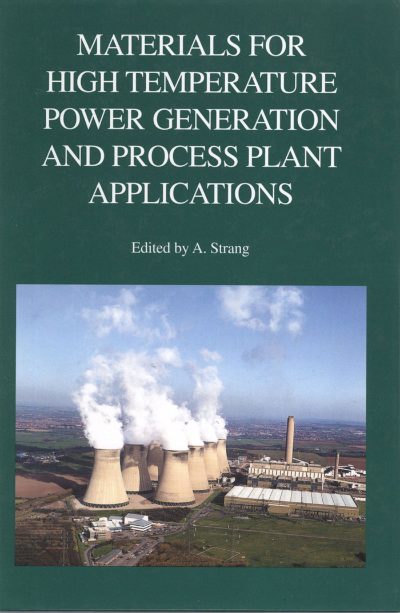
Materials for High-Temperature Power Generation and Process Plant Applications by A. Strang | PDF Free Download.

The Materials Contents


  • Progress in the Manufacture of Materials for Advanced High-Efficiency Steam Turbines
  • Material Developments for Supercritical Boilers and Pipework
  • Advanced Materials for Advanced Heat Exchangers
  • Welding and Fabrication of High-Temperature Components for Advanced Power Plant
  • Material Data Requirements for Assessing Defect Integrity at High Temperatures
  • A Review of Service Problems during High-Temperature Operation
  • Ferritic Power Plant Steels: Remanent Life Assessment and the Approach to Equilibrium 
  • Materials and Processes for High-Temperature Surface Engineering
  • High-Temperature Alloys for Advanced Industrial Gas Turbines
  • Ceramics in Aero Gas Turbines – an Engineer’s View

Foreword to Materials for High-Temperature Power Generation


Materials Congress ’98 – Frontiers in Materials Science and Technology, organized by the Institute of Materials, was held from 6-8 April 1998 at the Royal Agricultural College, Cirencester.

This .event, which was attended by more than 450 delegates from academia and industry, consisted of technical sessions dealing with materials issues involving rubbers, polymers, composites, ceramics, ferrous and nonferrous metals and alloys in applications ranging from the medical prosthesis to advanced power plant engineering.

These proceedings contain the ten most important papers presented in the session of the Congress concerned with materials for high-temperature power plant and process plant applications organized by the Institute of Materials High-Temperature Materials Performance Committee.

The selected papers are largely in the form of critical reviews that not only highlight the development of materials to meet specific applications but also comment on solutions used for both current and future applications.

The papers presented by Thornton and Fleming et ale are concerned with and highlight the problems associated with the selection of materials and manufacturing processes for critical components for large steam turbines and boiler plant where design lives in excess of 200 000 hours are now required at stresses of up to 300 bar and temperatures approaching 600°C.

Starr’s paper critically reviews materials for advanced heat exchanger applications such as those used in indirectly fired and recuperative gas turbines, fluidized bed combustion, coal gasification, and waste incineration systems, where the effects of corrosion often severely life-limits components.

The paper by Barnes et ale considers the key issues concerned with the welding and fabrication of key components for advanced power plant particularly in terms of their properties and expected service performance.

Material integrity is of paramount importance in critical components such as welded steam chests, pipework, and large rotors for large turbine generator applications, and the material considerations concerned with defect tolerance for such applications are critically reviewed in the paper by Holdsworth.

A review of typical problems encountered during the operation of the high-temperature plants is presented in the paper by Townsend while the extensive review by Bhadeshia et ale considers present assessment procedures for the life extension of power plant components.

The important role of surface engineering in the reliable operation of all high-temperature power and process plant is reviewed in the paper by Nicholls and Rickerby.

Significant developments are still continuing in this field with ‘designed surfaces’ likely to become a routine part of design procedures for many future components and plant applications.

Surface engineering already plays a significant part in ensuring that many gas turbine components such as blades, combustion cans, and other hot gas parts of the system achieve their planned design lives.

The paper by Pearcey considers these problems as well as others associated with the use of poor quality fuels and marine environments with the effects on the performance of high-temperature alloys in industrial gas turbine plants.

Finally Dominy et al. present an engineer’s view in a review of the application and role of ceramics and CMCs in modern aero gas turbines.

These reviews not only discuss the evolution of advanced materials for high-temperature power and process plant applications but also indicate the developments in materials that must take place to achieve the higher efficiency and environmentally acceptable plant for the 21st Century and beyond.

As this book goes to print Materials Congress 2000 is already planned for 12- 14 April 2000 and addressing the theme of Materials for the 21st Century

Download Materials for High-Temperature Power Generation and Process Plant Applications PDF Free.


[PDF] Modern Thermodynamics From Heat Engines to Dissipative Structures

Modern Thermodynamics From Heat Engines to Dissipative Structures


Book Details :
Language English
Pages 552
Format PDF
Size 8.68 MB

Modern Thermodynamics From Heat Engines to Dissipative Structures


Modern Thermodynamics From Heat Engines to Dissipative Structures 2nd Edition by Dilip Kondepud and Ilya Prigogine PDF Free Download

Modern Thermodynamics Contents


  • Basic Concepts and the Laws of Gases
  • The First Law of Thermodynamics 
  • The Second Law of Thermodynamics and the Arrow of Time 
  • Entropy in the Realm of Chemical Reactions
  • Extremum Principles and General Thermodynamic Relations 
  • Basic Thermodynamics of Gases, Liquids, and Solids
  • Thermodynamics of Phase Change
  • Thermodynamics of Solutions
  • Thermodynamics of Chemical Transformations
  • Fields and Internal Degrees of Freedom 
  • Thermodynamics of Radiation 
  • The Gibbs Stability Theory
  • Critical Phenomena and Configurational Heat Capacity
  • Entropy Production, Fluctuations and Small Systems 
  • Nonequilibrium Thermodynamics: The Foundations
  • Nonequilibrium Thermodynamics: The Linear Regime
  • Nonequilibrium Stationary States and Their Stability: Linear Regime 
  • Nonlinear Thermodynamics 
  • Dissipative Structures
  • Elements of Statistical Thermodynamics 
  • Self-Organization and Dissipative Structures in Nature

Preface to Modern Thermodynamics From Heat Engines


The first edition of this book was published in 1998 and we were pleased that it was well-received. It has been used in over 25 countries as a text for courses in physics, chemistry, and engineering, and it has been translated into French, Italian, Japanese, Portuguese, and Russian.

Thermodynamics as formulated in the twentieth century, what we chose to call ‘Modern Thermodynamics’ is a theory of irreversible processes in contrast to nineteenth-century thermodynamics, which is a theory of states.

In the latter, thermodynamics is confined to initial and final states, the processes that transform a state are not central to the theory; they are treated as another subject, ‘kinetics’. In Modern Thermodynamics, however, entropy-increasing irreversible processes are central to the theory.

In it, we find additional tools, such as the rate of entropy production, to characterize and analyze nonequilibrium systems, and new results, such as the Onsager reciprocal relations, that are applicable to the thermoelectric effect, thermal diffusion and other cross-effects.

The context in which thermodynamics is being taught is rapidly changing. Therefore we have added new sections to chapters, which show more applications of the subject.

The following is a partial list. In Chapter 2 we have included ‘energy flows’ in turbines and jet engines, and basics of renewable energies such as solar and wind energy.

We have also included a description of the hurricane as a heat engine in Chapter 3. Chapter 11 now has sections on nonequilibrium electromagnetic radiation. In Chapter 19, we have included rates of entropy production in dissipative structures.

In response to suggestions by users of this text, we have included a chapter on Statistical Thermodynamics, which makes this text self-contained by the inclusion of derivations of heat capacities of solids and Planck’s law of blackbody radiation.

Several other changes have been made to improve the presentation of the concepts. Entropy and entropy-producing irreversible processes are generally thought of as agents of disorder.

A central message of this book is that, under far-from-equilibrium conditions, irreversible processes are, in fact, the drivers of self-organization and order we see all around us in Nature.

These emergent structures, called dissipative structures, are distinct from machines and are a good thermodynamic basis on which we may begin to build a theory of biological organisms.

It is an important direction for future developments in thermodynamics. We have included a section on this topic in the final chapter.

Preface to Modern Thermodynamics From Heat Engines First Edition


Why Thermodynamics?

Since half a century ago, our view of Nature has changed drastically. Classical science emphasized equilibrium and stability. Now we see fluctuations, instability, evolutionary processes on all levels from chemistry and biology to cosmology.

Everywhere we observe irreversible processes in which time symmetry is broken. The distinction between reversible and irreversible processes was first introduced in thermodynamics through the concept of ‘entropy’, the arrow of time, as Arthur Eddington called it.

Therefore our new view of Nature leads to an increased interest in thermodynamics. Unfortunately, most introductory texts are limited to the study of equilibrium states, restricting thermodynamics to idealized, infinitely slow reversible processes.

The student does not see the relationship between irreversible processes that naturally occur, such as chemical reactions and heat conduction, and the rate of increase of entropy.

In this text, we present a modern formulation of thermodynamics in which the relation between the rate of increase of entropy and irreversible processes is made clear from the very outset. Equilibrium remains an interesting field of inquiry but in the present state of science, it appears essential to include irreversible processes as well.

It is the aim of this book to give a readable introduction to present-day thermodynamics, starting with its historical roots as associated with heat engines but including also the thermodynamic description of far-from-equilibrium situations.

As is well known today, far-from-equilibrium situations lead to new space-time structures. For this reason, the restriction to equilibrium situations hides, in our opinion, some essential features of the behavior of matter and energy. An example is the role of fluctuations.

The atomic structure of matter leads to fluctuations. However, at equilibrium or near equilibrium, these fluctuations are inconsequential. Indeed a characteristic feature of equilibrium thermodynamics is the existence of extremum principles.

For isolated systems entropy increases and is therefore maximum at equilibrium. In other situations (such as constant temperature) there exist functions called thermodynamic potentials which are also extrema (that is maximum or minimum) at equilibrium.

This has important consequences. A fluctuation that leads to a temporal deviation from equilibrium is followed by a response that brings back the system to the extremum of the thermodynamic potential. The equilibrium world is also a stable world.

This is no longer so in far-from-equilibrium situations. Here fluctuations may be amplified by irreversible dissipative processes and lead to new space-time structures which one of us (I. Prigogine) has called ‘dissipative structures’ to distinguish them from ‘equilibrium’ structures such as crystals.

Therefore the distance from equilibrium becomes a parameter somewhat similar to temperature. When we lower the temperature, we go from the gaseous state to a liquid and then a solid. As we shall see, here the variety is even greater.

Take the example of chemical reactions. Increasing the distance from equilibrium we may obtain in succession oscillatory reactions, new spatial periodic structures, and chaotic situations in which the time behavior becomes so irregular that initially, close trajectories diverge exponentially.

One aspect is common to all these nonequilibrium situations, the appearance of long-range coherence. Macroscopically distinct parts become correlated.

This is in contrast to equilibrium situations where the range of correlations is determined by short-range intermolecular forces. As a result, situations that are impossible to realize at equilibrium become possible in far-from-equilibrium situations.

This leads to important applications in a variety of fields. We can produce new materials in nonequilibrium situations where we escape from the restrictions imposed by the phase rule. Also, nonequilibrium structures appear at all levels in biology.

We give some simple examples in Chapters 19 and the postface. It is now generally admitted that biological evolution is the combined result of Darwin’s natural selection as well as of self-organization, which results from irreversible processes.

Since Ludwig Boltzmann (1844–1906) introduced a statistical definition of entropy in 1872, entropy is associated with the disorder.

The increase of entropy is then described as an increase of disorder, as the destruction of any coherence that may be present in the initial state. This has unfortunately led to the view that the consequences of the Second Law are self-evident, are trivial.

This is, however, not true even for equilibrium thermodynamics, which leads to highly nontrivial predictions. Anyway, equilibrium thermodynamics covers only a small fraction of our everyday experience.

We now understand that we cannot describe Nature around us without an appeal to nonequilibrium situations.

The biosphere is maintained in nonequilibrium through the flow of energy coming from the Sun and this flow is itself the result of the nonequilibrium situation of our present state of the universe.

It is true that the information obtained from thermodynamics both for equilibrium and nonequilibrium situations is limited to a few general statements.

We have to supplement them by the equation of state at equilibrium or the rate laws, such as chemical reaction rates. Still, the information we obtain from thermodynamics is quite valuable precisely because of its generality.


Modern Thermodynamics: From Heat Engines to Dissipative Structures PDF

Author(s): Dilip Kondepudi, Ilya Prigogine

Publisher: Wiley, Year: 2014

ISBN: 111837181X


Download Modern Thermodynamics From Heat Engines to Dissipative Structures PDF Free


[PDF] Rotor Systems Analysis and Identification by Rajiv Tiwari

0

rotor systems analysis and identification rotor systems analysis and identification by rajiv tiwari


Guide Particulars :
Language English
Pages 1091
Format PDF
Dimension 16.6 MB

Rotor Systems, Analysis and Identification by Rajiv Tiwari

Book Description:

The purpose of this book is to give a basic understanding of rotor dynamics phenomena with the help of simple rotor models and subsequently, the modern analysis methods for real life rotor systems. This background will be helpful in the identification of rotor-bearing system parameters and its use in futuristic model-based condition monitoring and, fault diagnostics and prognostics. The book starts with introductory material for finite element methods and moves to linear and non-linear vibrations, continuous systems, vibration measurement techniques, signal processing and error analysis, general identification techniques in engineering systems, and MATLAB analysis of simple rotors.

Key Features:

• Covers both transfer matrix methods (TMM) and finite element methods (FEM)

• Discusses transverse and torsional vibrations

• Includes worked examples with simplicity of mathematical background and a modern numerical method approach

• Explores the concepts of instability analysis and dynamic balancing

• Provides a basic understanding of rotor dynamics phenomena with the help of simple rotor models including modern analysis methods for real life rotor systems.


PREFACE to Rotor Systems, Analysis and Identification by Rajiv Tiwari:

This Rotor Systems, Analysis and Identification by Rajiv Tiwari e book is the result of an elective course on “Rotor Dynamics” supplied by me to undergraduate, graduate, and postgraduate college students at IIT Guwahati over the past 18 years. It accommodates materials on among the analysis work achieved by me with my graduate college students.

Hopefully, the content material will likely be helpful for classroom instructing and will function a reference Rotor Systems, Analysis and Identification by Rajiv Tiwari e book for pursuing analysis and improvement within the subject of rotor dynamics.

In a broader sense, rotor dynamics covers a number of subjects, specifically modeling, evaluation, measurement, sign processing, identification, situation monitoring, and management of rotor-bearing methods.

The modeling and evaluation of rotor-bearing dynamics have now reached a mature state. The finite aspect technique (FEM) and the switch matrix technique (TMM) have been used extensively for modeling and analyses of rotor methods.

Till immediately, monitoring the situation of rotor-bearing methods based mostly on vibrations was primarily involved with feature-based fault detection and diagnostics.

On account of this, the strategies obtainable to date will not be dependable and failsafe based on the expectations of fellow engineers working within the subject. For model-based situation monitoring of rotor-bearing methods, identification strategies for system parameters are beneath improvement.

By way of figuring out rotor system parameters, from the obtainable literature a variety of prospects have appeared within the subject.

The aim of this course materials is to present a primary understanding of the rotor dynamics phenomena with the assistance of some easy rotor fashions and trendy evaluation strategies for real-life rotor methods.

This background will likely be useful within the identification of rotor-bearing system parameters and its use in futuristic model-based situation monitoring and fault prognosis and prognostics.

The content material of the current Rotor Systems, Analysis and Identification by Rajiv Tiwari e book is in two main components as title of the Rotor Systems, Analysis and Identification by Rajiv Tiwari e book additionally suggests, the primary is the modeling and evaluation of rotor phenomena, and the second is the situation monitoring of rotor methods and related identification of system parameters.

The primary half principally offers with principle associated to dynamic evaluation of easy rotors, which is able to give a scientific presentation of among the rotor dynamic phenomena within the transverse and torsional vibrations with the assistance of easy rotor mathematical fashions.

However for analyzing complicated rotors which might be utilized in apply, the free and compelled response analyses of multi-DOF rotor system have been introduced.

The Euler-Bernoulli and Timoshenko beam fashions have been thought of in transverse vibration evaluation.

The current Rotor Systems, Analysis and Identification by Rajiv Tiwari e book materials retains a stability between the switch matrix technique (TMM) and the finite aspect technique (FEM) for the evaluation of complicated rotors.

Nonetheless, the FEM is probably the most sensible method and it may be utilized to very massive complicated rotor-bearing-foundation methods with its simple implementation in pc code and as a consequence of improvement within the condensation or discount schemes to scale back computation effort and time.

The dynamic evaluation of rotors accommodates discovering the whirl pure frequency, mode shapes, Campbell diagram, crucial speeds, unbalance responses and instability frequency bands.

Aside from standard bearings, i.e. the rolling aspect and hydrodynamic bearings, and dynamic seals and dampers, the current Rotor Systems, Analysis and Identification by Rajiv Tiwari e book additionally contact upon the modern energetic magnetic bearings and related rotor unbalance response and instability analyses for the inflexible and versatile rotors.

The second half principally accommodates the sensible facet of rotor methods associated to the situation monitoring and system identification.

Rotor Systems: Analysis and Identification PDF

Author(s): Rajiv Tiwari

Publisher: CRC Press, Year: 2018

ISBN: 1138036285,978-1-138-03628-4

Download Rotor Systems, Analysis and Identification by Rajiv Tiwari PDF


Download

[PDF] Convection Heat Transfer by Adrian Bejan


Guide Particulars :
Language English
Pages 685
Format PDF
Dimension 5.30 MB

Convection Heat Transfer 4th Version by Adrian Bejan


Convection Heat Transfer 4th Version by Adrian Bejan PDF Free Download.

Convection Heat Transfer Contents


  1. Elementary Rules
  2. Laminar Boundary Layer Circulation
  3. Laminar Duct Circulation
  4. Exterior Pure Convection
  5. Inner Pure Convection
  6. Transition to Turbulence
  7. Turbulent Boundary Layer Circulation
  8. Turbulent Duct Circulation
  9.  Free Turbulent Flows
  10. Convection with Change of Section
  11. Mass Transfer
  12. Convection in Porous Media

Preface to Convection Heat Transfer PDF


An creator is lucky if his e book is common sufficient to advantage a second version someplace down the road, but the move of concepts that grew round this e book for the reason that first version (1988) has been past expectations. I’ll let others touch upon this move.

On this transient Preface, I touch upon only one characteristic of the move of concepts and one little bit of historical past. The move of concepts is illustrated by the modifications made on this re-creation.

Good concepts (on this or some other area) appeal to attention-grabbing minds— researchers, educators, and authors with concepts.

These minds develop the sphere the best way that the yeast grows the cake. Whereas revising this version, it was not attainable to maintain up with this progress, however I attempted, though this meant abandoning a few of the materials from earlier editions.

The brand new progress is represented by the impression of the science of discovering efficient move configurations (constructal principle and design),

the streamlining of the self-discipline alongside strategies which can be direct, muscular, and on the identical time lean (scale evaluation, intersection of asymptotes, heatlines),

the oneness with thermodynamics via the irreversibility (entropy technology) phenomenon, and new references and issues on the finish of chapters.

As a result of we all know the place convection and thermodynamics come from, this progress illustrates that science (training, information, data) is an evolutionary design [1–4],

a move system that continually morphs and improves in order that our personal motion and life are facilitated and prolonged on the panorama.

That is nature, the animate and the inanimate alike. As a result of analysis is autobiographical, good analysis is a e book of fantastic recollections. I shut this preface with the story of how the primary version of this e book was born. It was an accident, actually.

At age 33, I used to be behaving as if I used to be meant to play basketball eternally, and I used to be incorrect. Throughout a recreation in January 1982, one in every of my Achilles’ tendons was severed, and I ended up in a wheelchair for the complete semester.

I needed to educate my convection course, for which I had written notes, however this time I used to be pressured to put in writing every lecture on transparencies, for the display. My first graduate scholar, Shigeo Kimura, now professor at Kanazawa College, Japan, was my instructing assistant.

He would wheel me into the classroom each morning, and my convection e book would come to life, one unique drawing at a time, one unique (solved) drawback after one other.

One such drawback was the tactic of intersecting the asymptotes and the back-of-the-envelope prediction of optimum spacings (Downside 11, Chapter 4, p. 157, within the first version).

There was a lot richness in the course of the spring of 1982 that the accident was a blessing.

Solutions Manual for Convection Heat Transfer

Author(s): A. Bejan and J. A. Jones

Download


Convection Heat Transfer, Fourth Edition PDF

Author(s): Adrian Bejan(auth.)

Year: 2013

ISBN: 9780470900376,9781118671627

Download Convection Heat Transfer 4th Version by Adrian Bejan PDF Free.

[PDF] Finance Capital Markets Financial Management and Investment Management

0


Ebook Particulars :
Language English
Pages 833
Format PDF
Dimension 4.47 MB

Finance Capital Markets Financial Management and Investment Management


Finance Capital Markets, Financial Management, and Investment Management by Frank J. Fabozzi and Pamela Peterson Drake PDF Free Download.

Finance PDF Contents


  • PART ONE Background 
  • PART TWO Capital Markets and Capital Market Concept
  • PART THREE Financial Management 
  • PART FOUR Investment Management

Preface to Finance PDF


Latest monetary occasions have emphasised the necessity for an understanding of economic decision-making, financing devices, and methods utilized in monetary and funding administration.

On this e-book, we offer an introduction to those subjects within the fi eld of fi nance. We start our introduction to finance in Half One, the place we introduce you to fi nancial arithmetic and fi nancial evaluation. These are the fundamental instruments of fi nance that span funding and fi nancing decision-making.

In Half Two, we develop the basics of capital market concept and talk about fi nancial markets, fi nancial intermediaries, and regulators of fi nancial actions.

Information of capital markets and how belongings are priced is important to decision-making that entails elevating capital within the markets or investing capital.

In this half, we additionally cowl the fundamentals of rates of interest, bond and inventory valuation, asset pricing concept, and by-product devices. We current the decision-making inside a enterprise enterprise in Half Three.

These selections embody capital budgeting—that’s, whether or not or to not spend money on specifi c long-lived tasks—and capital construction—that’s, how one can fi nance the enterprise. On this half, we additionally talk about the administration of present belongings and danger administration.

In Half 4, we cowl the fundamentals of funding decision-making, starting with the dedication of an funding goal and then continuing to debate and exhibit portfolio concept and efficiency analysis.

As well as, we talk about primary methods for managing fairness and bond portfolios, and using futures and choices in portfolio administration.

We cowl a whole lot of floor on this e-book, offering a complete overview of fi nance.

We take the reader, who might have little or no familiarity with fi nance, to a degree of understanding that provides the reader a greater appreciation for the complicated monetary points that corporations and traders face right now.

The strategy on this e-book is completely different from the normal e-book that’s utilized in an introductory undergraduate or MBA finance course. In such programs, the main focus is on fi nancial administration (additionally known as company fi nance or enterprise fi nance).

We consider {that a} extra acceptable course covers capital markets and funding administration, and that’s the main motivation for scripting this e-book.

Furthermore, we consider there are subjects which might be usually uncared for in fi nancial administration programs that we cowl on this e-book: fi nancial technique, fi nancial engineering, asset securitization, and fi nancial danger administration.

We hope that the reader benefi ts from our broader perspective of subjects.

Finance: Capital Markets, Financial Management, and Investment Management PDF

Author(s): Frank J. Fabozzi CFA, Pamela Peterson Drake

Series: Frank J. Fabozzi Series

Publisher: Wiley, Year: 2009

ISBN: 0470407352

Download Finance by Fabozzi and Drake PDF Free.

Download

Download